
Clean Morning Routine Swaps: A Seven-Product Side-by-Side

A clean morning routine swap covers the seven products most people touch before they leave the house: cleanser, moisturizer, SPF, deodorant, body lotion, hair product, and toothpaste. Replacing all seven cuts daily exposure to fragrance, parabens, and PEGs by an estimated 80%. You don’t have to swap every product the same day, the math still works if you stagger the changes over a few weeks and start with the highest-exposure offenders.
In a household of five with multiple bathrooms, the morning routine is the most product-dense fifteen minutes of the day. Seven categories, seven decisions and most of those decisions get made once at the store and then quietly repeated for years. The side-by-side comparison most shoppers run is brand versus brand on the same shelf. The side-by-side that actually matters is the conventional stack versus the clean stack across all seven categories, because it’s the cumulative deck, not any single ingredient, that adds up to daily exposure.
This is not the time to overhaul your entire bathroom by Friday. I’m suggesting you seek to know what’s stacked on your counter SO YOU CAN decide which swaps are worth making first.
The Seven-Product Morning Stack, Side by Side
Before you reach for the door each morning, you’ve already used somewhere between five and ten personal-care products. Seven is the median for most adults: cleanser, moisturizer, SPF, deodorant, body lotion, hair product, toothpaste. Each one touches a different patch of skin, or mucous membrane, in the case of toothpaste, and each one carries a different ingredient deck. The conventional version of that stack tends to share a small handful of repeat offenders: fragrance, parabens, sulfates, PEGs, and a few preservatives most people couldn’t pronounce.
Here’s the side-by-side, drawn from the typical mainstream pick in each category against what the clean swap criteria actually look like.
| Product | Typical Conventional Pick | Common Skip Ingredients | Clean Swap Criteria |
|---|---|---|---|
| Cleanser | Foaming face wash with parfum and SLS | Fragrance, SLS, SLES, MI/MCI | Sulfate-free, fragrance-free, clearly labeled ingredient list |
| Moisturizer | Drugstore lotion with fragrance and parabens | Fragrance, parabens, dimethicone | Fragrance-free, no parabens, named humectants like glycerin or sodium hyaluronate |
| SPF | Chemical sunscreen with oxybenzone or octinoxate | Oxybenzone, octinoxate, homosalate | Mineral SPF (non-nano zinc oxide), reef-safe, full ingredient transparency |
| Deodorant | Antiperspirant with aluminum, propylene glycol, and parfum | Aluminum chlorohydrate, parabens, fragrance, PEG | Aluminum-free, fragrance-free or essential-oil only, magnesium- or baking-soda-based |
| Body lotion | Pump bottle with parfum and parabens | Fragrance, parabens, PEG, mineral oil base | Same skip list as moisturizer, plus avoid mineral oil as primary emollient |
| Hair product | Shampoo with SLS and parfum; gel/spray with PEG | SLS, SLES, parabens, fragrance, PEG | Sulfate-free, fragrance-free or EO-only, no PEG |
| Toothpaste | SLS, triclosan, artificial dyes (fluoride aside) | Triclosan, SLS, propylene glycol, artificial colorants | SLS-free, no triclosan, hydroxyapatite or fluoride per personal preference |
The pattern that jumps out the moment you put them in a row: it’s the same six or seven ingredients showing up in product after product. Which means a single morning-routine swap doesn’t just remove one exposure, it removes the same molecule from four or five places at once.
Why the Stack Matters More Than Any Single Product
This is the piece the per-product conversation usually misses. If you only swap your face cream and call it done, you’ve changed a few hundred square centimeters of skin contact. Helpful, but the parabens you wanted to avoid are also in your body lotion, your hair conditioner, and your toothpaste. Same molecule, same body, four more delivery vehicles.
This is what people mean when they talk about cumulative exposure. The European Commission’s Scientific Committee on Consumer Safety has flagged this stacking problem in its post-market reviews: a single ingredient can pass a margin-of-safety threshold in one product class and fail it once you account for the same ingredient appearing across the entire daily routine. The U.S. system reviews each product in isolation. Your body, of course, does not.
That’s the case for thinking about the morning routine as a stack rather than a list. Brand-A versus brand-B of the same product is the side-by-side you do at the shelf. Conventional stack versus clean stack across all seven categories is the side-by-side that actually moves the exposure number, because the swaps compound.
For the mechanism of action on the specific molecules driving the stacking problem, the five endocrine disruptors probably on your counter right now walks through what each one does once it’s absorbed.
Where to Start: The 80/20 of Clean Morning Routine Swaps
Clean morning routine swaps don’t have to happen all at once. If I were starting tomorrow with a bathroom full of conventional products, here’s the order I’d run, top-down by exposure:
-
Deodorant first. Most concentrated, applied closest to the lymph nodes, used daily, almost never rinsed off. Aluminum and parabens are the two molecules to leave behind. Look for aluminum-free, fragrance-free or essential-oil only, with magnesium hydroxide or baking soda doing the work.
-
Body lotion next. Second-largest surface-area contact after body wash, and most pump bottles contain fragrance plus parabens — the trifecta you’re trying to remove from the rest of the routine. The covered ground here is enormous; the deep dive on body wash walks through the surface-area math that applies to body lotion identically.
-
SPF. This is the one most people get wrong by reflex, they default to whatever the dermatologist’s office sample drawer happened to stock. Mineral SPF using non-nano zinc oxide is the cleanest option; chemical filters like oxybenzone and octinoxate are flagged endocrine disruptors and are increasingly banned in marine sanctuaries for reef impact.
-
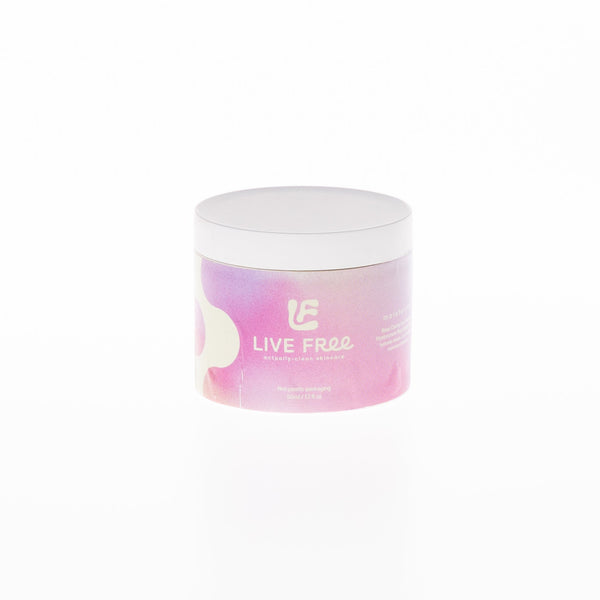
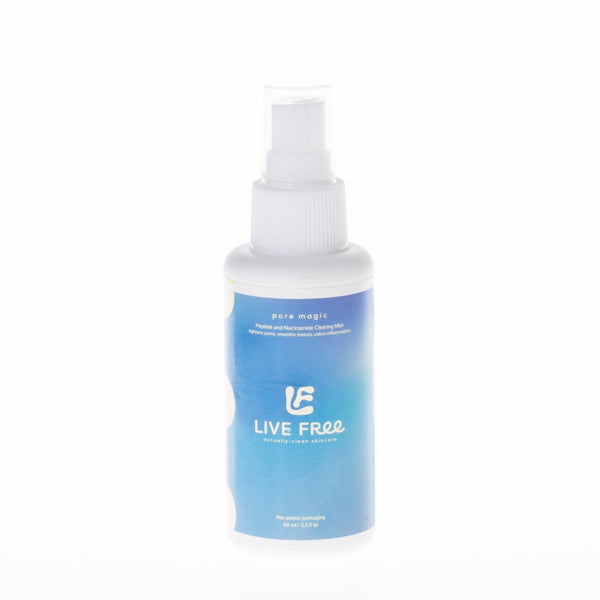
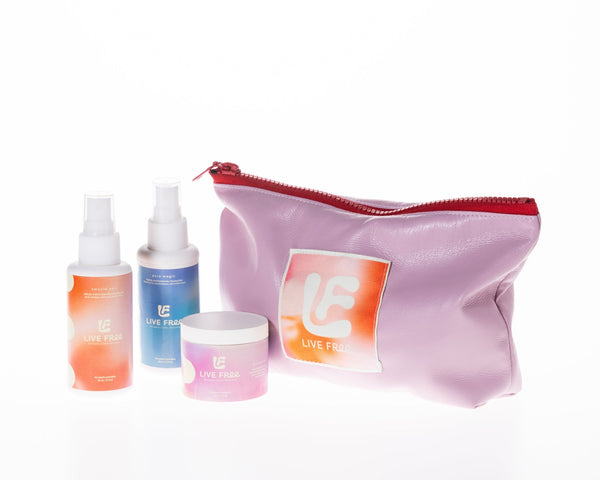
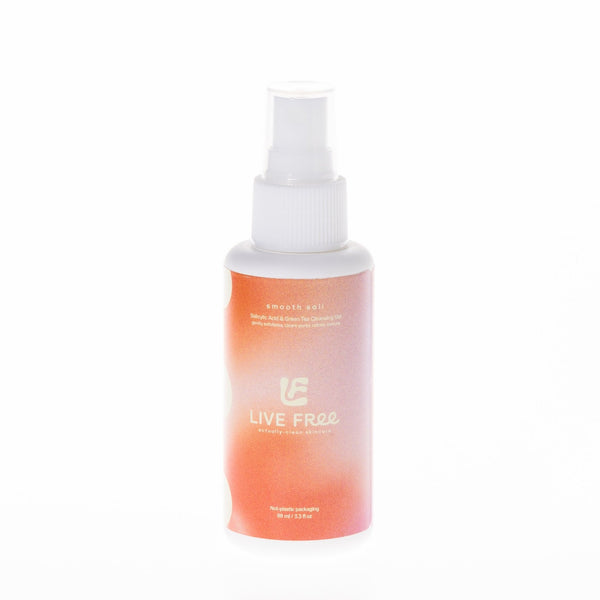
Cleanser and moisturizer. Smaller surface area but high-frequency contact, twice daily for most people. The Live Free Skincare line was built precisely for this swap: Smooth Sali ($36, gentle salicylic-acid cleanser), Pore Magic ($39, peptide and niacinamide toner mist), and Moisturose ($42, rosa-canina-and-ceramide moisturizer). All three are MADE SAFE certified, fragrance-free, sulfate-free, paraben-free, phthalate-free, and silicone-free.
-
Hair product. Shampoo is the high-frequency touchpoint here, but it rinses off, so the exposure profile is different than leave-on body lotion. Still worth swapping. Sulfate-free with no parfum is the floor.
-
Toothpaste. Smallest absolute exposure of the seven, but the mucous-membrane route makes it punch above its weight. Skip triclosan, SLS, and artificial dyes. The fluoride question is its own conversation, that one is personal preference and worth a separate post.
The 30-Day Reality Check
After a complete swap, the two things people tend to notice in the first month are subtle: skin that feels less reactive (because the cumulative fragrance exposure is gone) and a routine that takes about the same amount of time as it did before. The “clean routine takes forever” objection is a marketing myth — a tube is a tube, a pump is a pump. What changes is the back label, not the pump count.
The other thing worth saying out loud: clean morning routine swaps are not an all-or-nothing project. They’re a replacement cycle. The point isn’t the bottle currently on your counter. The point is the next bottle you buy. If you swap one product per month, you’ll be through all seven before the end of the year — without throwing away anything unused, without spiking the household budget in a single week, and without the kind of overhaul that tends to get abandoned by week three.
If you want a curated shortcut, the bath and body collection is screened against the exact skip list above — every deodorant, body lotion, hair product, and body wash on it has been read against this list before it gets shelved. That’s the side-by-side we run on every product before we’ll carry it.
Live Free,
Dana Grinnell
Founder of Free Living Co & Live Free Skincare
FAQ
What’s the easiest clean swap to start with?
Deodorant. It’s the highest-concentration, highest-frequency application of the seven morning products, applied directly to thin underarm skin near the lymph nodes, and almost never rinsed off. An aluminum-free, fragrance-free deodorant removes three of the most common conventional offenders in one swap. It’s also psychologically the easiest — you’ll know within two weeks whether the formula works for your body chemistry, and the financial commitment is low compared to a full skincare overhaul.
Are clean products as effective as conventional?
For the morning stack, yes — with a one-product caveat. Clean SPF using mineral filters performs equivalently for sun protection but has a different aesthetic feel and can leave a slight cast on deeper skin tones. Clean deodorants take about two weeks of adjustment as your skin recalibrates from antiperspirant. Cleansers, moisturizers, hair products, and body lotion perform identically once you’ve matched the right formula type to your skin and hair.
How much more expensive is a clean morning routine?
Less than people assume. The premium on a clean swap averages 20 to 40 percent versus mid-tier conventional, but the comparison gets tighter against prestige conventional brands — clean products are often priced below department-store equivalents because they’re skipping the synthetic-fragrance and packaging budget that drives those prices up. Per-day cost across the seven products tends to land within a dollar of a conventional drugstore stack.
What conventional product is the worst offender?
Antiperspirant deodorant. The combination of aluminum chlorohydrate, parabens, propylene glycol, and synthetic fragrance — applied daily to a high-absorption area near the lymph nodes and almost never rinsed off — gives it the highest single-product cumulative exposure score in most morning routines. Body lotion is close behind because of surface area, and any heavily fragranced leave-on product comes in third.
Where do I start if I can’t swap everything?
Pick the highest-frequency, highest-concentration product first — usually deodorant — and replace that one. Then wait until your next moisturizer or body lotion runs out and swap that one. Don’t toss unfinished bottles unless they actively irritate you; financial waste is not a clean-living value. The point of clean morning routine swaps is the next bottle you buy, not the current one. Replace at the natural cycle, and you’ll be through the stack inside a year.
Shop the article
Products mentioned in this story — each one clears our standard.




How clean is clean?
Read the exact process behind every product we sell.
Read more →
The marketplace for skin-healthy living — clean skincare, beauty, supplements, home care & wellness. Live free.
1476 Newpark Blvd, Ste 100
Park City, UT 84098
Open Mon–Sat 10am–5pm