
What Is Sustainable Skincare, Really? How Live Free Skincare Is Rethinking Plastic Packaging

Sustainability in beauty means reducing harm across a product’s entire lifecycle—from ingredients to packaging to shipping—without relying on confusing buzzwords or greenwashing. One of the biggest opportunities? Eliminating single-use plastic, especially in skincare packaging.
Key takeaways:
- The beauty industry produces ~120 billion units of plastic packaging every year, much of which is never recycled.
- “Recyclable” doesn’t always mean recycled, especially in bathrooms.
- Plant-based and bio-based materials aren’t automatically sustainable (some still create microplastics).
- Truly sustainable skincare looks at materials, formulas, packaging, and shipping together.
- Brands like Live Free Skincare show that plastic-free packaging is possible, even for small indie brands.
Why is sustainability such a big issue in the beauty industry?
Let’s start with the stat that made us say, hold the phone.
The global beauty industry produces an estimated 120 billion units of packaging every year with the majority of it plastic. That includes bottles, pumps, caps, tubes, seals, droppers, and secondary packaging. And while many of these items are technically labeled “recyclable,” the reality is much messier.
Most beauty packaging:
- Is too small to make it through recycling sorters
- Is made from mixed materials (hello, pump tops)
- Is colored or coated in ways recycling facilities can’t process
- Or (very honestly) gets tossed into the bathroom trash instead of carried downstairs to the recycling bin
Even when plastic does make it into the recycling stream, the process itself is resource-intensive and results in downcycled plastic—material that is less stable and often not ideal for holding personal care products.
What does “sustainable” actually mean when it comes to skincare?
Here’s where things get confusing (and where greenwashing loves to thrive).
“Sustainable” isn’t one thing. In beauty, it can refer to several different approaches, all of which sound good on a label but don’t always deliver the same environmental impact.
1. Recyclable packaging
This means the material can be recycled under ideal conditions.
The catch: If the infrastructure, consumer behavior, or material design doesn’t support it, recyclable packaging still ends up in landfills.
2. Recycled plastic (PCR)
Using post-consumer recycled plastic helps reduce demand for virgin plastic.
The catch: Recycled plastic is often less stable, may degrade faster, and can leach unwanted compounds, which is especially problematic for skincare.
3. Refillable or reusable packaging
This can be a great solution when systems are convenient and widely adopted.
The catch: Many refill programs require shipping refills separately, increasing emissions, or rely on consumer follow-through that doesn’t always happen.
4. Plant-based or bio-based resins
These materials are derived from plants instead of fossil fuels.
The catch: Not all plant-based plastics biodegrade cleanly. Some break down into—you guessed it—microplastics.
5. Zero-waste or biodegradable packaging
This is where things get exciting when done correctly.
True biodegradable packaging breaks down into natural elements without leaving microplastics behind—and does so in real-world conditions, not just lab-perfect industrial composting.
How much of sustainability is just greenwashing?
Unfortunately? A lot.
Buzzwords like eco-friendly, clean, green, and natural are largely unregulated in beauty. That means brands can use them without proving meaningful environmental impact.
Common greenwashing red flags:
- Vague claims without material details
- Emphasis on one “green” feature while ignoring the rest
- Recyclable packaging without education or systems to support it
- Sustainability talk that doesn’t include packaging at all
This is why transparency matters—and why we’re big believers in brands that explain the how and why, not just the headline.
Why skincare packaging is one of the biggest opportunities for change
Here’s our (very passionate) take:
The beauty industry has one of the clearest paths to reducing or eliminating plastic for good.
Skincare packaging is:
- Predictable in size and use
- Often used daily
- Produced at massive scale
If we can rethink this category, the impact on landfills—and our homes—is huge.
How Live Free Skincare approaches sustainability differently
When Live Free Skincare was created, limiting plastic wasn’t an afterthought—it was a core objective, second only to creating the cleanest formulas possible for young skin.
And that part matters.
We didn’t set out to launch another skincare line. Live Free was born after nearly two years of searching for something that simply didn’t exist while curating the Free Living Co marketplace:
A skincare line for teen and twenty-something skin that was:
- Clean without endocrine disruptors or grey‑area ingredients
- Truly sustainable (because this generation genuinely cares)
- Formulated with real active ingredients that actually deliver results
When it became clear that the gap wasn’t going to be filled… Live Free was built.
Live Free Skincare is actually sustainable (not just marketed that way).
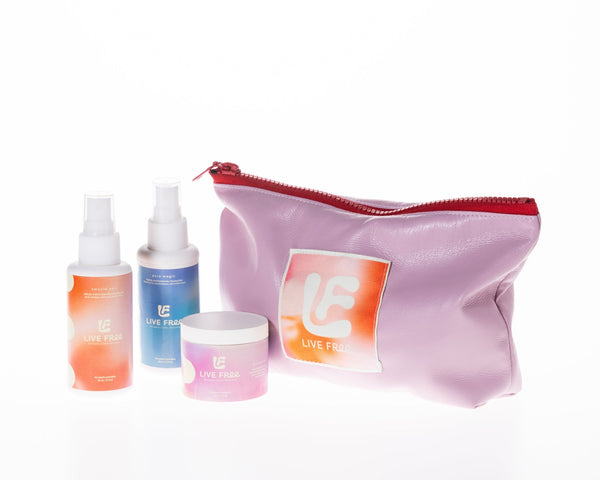
Live Free Skincare packaging is designed to work beautifully in real life—and then disappear responsibly when its job is done.
Here’s what makes it different:
- Super stable in use, then biodegrades in weeks into CO₂ and water
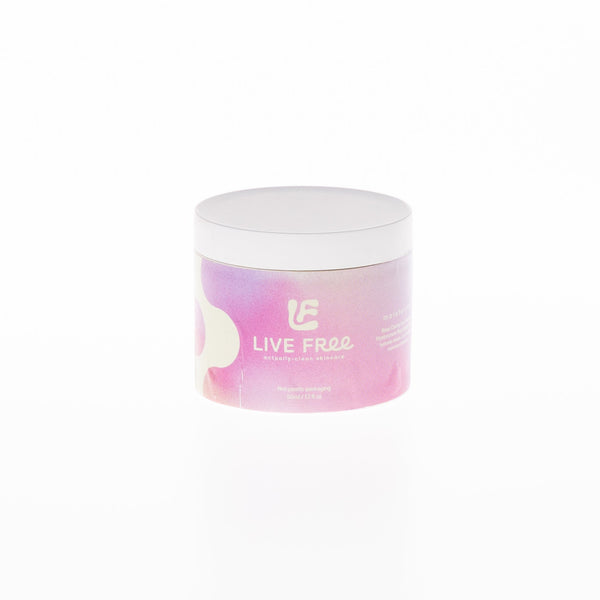
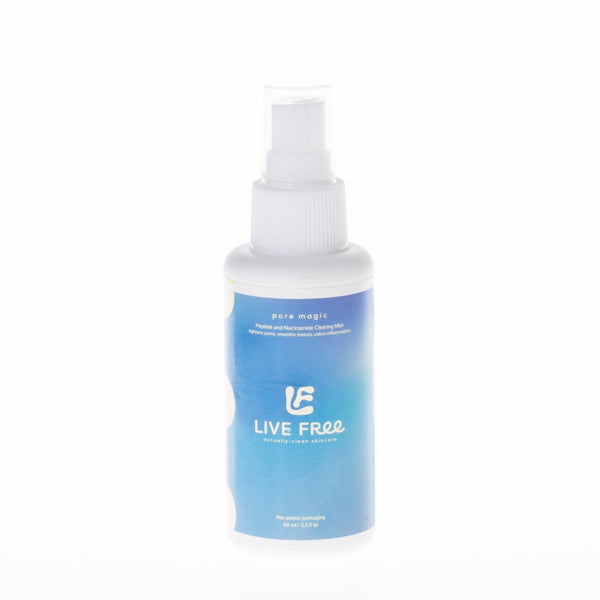
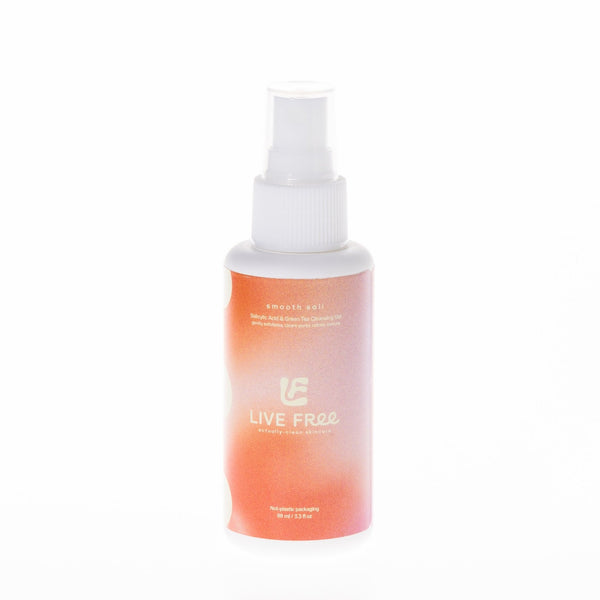
- Bottles, tubs, and lids are not plastic—they’re bio‑based, petroleum‑free, and microplastic‑free
- 0% plastic: compost at home or toss in the trash, and the packaging disappears in ~16 weeks
The material behind this innovation is Vivomer, a next-generation bio-based material made from waste biomass from plants. While in use, it’s shelf‑stable and sink‑safe. Once disposed of, it biodegrades in home compost, industrial compost, landfill, or even aquatic environments—without fragmenting into microplastics.
Some plant-based resins still create microplastics (no joke). Vivomer doesn’t.
Sustainability beyond the bottle: secondary packaging that saves waste
Instead of traditional packaging, Live Free Skincare products are shipped in repurposable pouches made from deadstock fabric.
What is deadstock? Deadstock is pre-consumer fabric that never makes it into clothing and typically ends up in landfills. An estimated 92 million tons of fabric are discarded every year.
By recovering deadstock:
- No new fabric is produced
- Perfectly usable material is saved from landfills
- Every pouch is inherently limited edition
Because each roll of deadstock fabric is scarce, pouches vary—and that’s part of the story. It’s sustainability that’s practical, creative, and refreshingly honest.
Why small brands leading the way matters
Here’s the part we’re shouting from the rooftops:
If a very small, indie beauty brand can create plastic-free, compostable skincare packaging—so can the rest of the industry.
Innovation doesn’t require massive corporations. It requires priorities.
Live Free Skincare proves that sustainability isn’t a future goal, it’s a current choice.
How Free Living Co defines sustainability (hint: it’s not perfection)
At Free Living Co, sustainability is about real-life impact, not idealized systems that only work on paper.
Our approach includes:
- Prioritizing brands with vetted, transparent sustainability practices
- Offering a wide product assortment so customers can bundle items into one shipment. Think everything from floor cleaner, to lip balms, to skincare faves.
- Reducing unnecessary packaging whenever possible
- Supporting brands that balance performance and planet
Because sustainability also means making clean living accessible, not overwhelming.
So… what can you do as a consumer?
Let’s take a collective exhale here.
You do not need to throw away everything in your bathroom, replace your entire routine, or become a sustainability expert overnight. That kind of pressure is exactly what makes people opt out altogether—and that’s not helpful for anyone (or the planet).
At Free Living Co, we believe sustainability should feel doable, not daunting. Real life, real bathrooms, real habits. The goal isn’t perfection, it’s momentum.
Start by:
1. Question sustainability claims (even the pretty ones)
If a brand says it’s “eco-friendly,” “green,” or “clean,” it’s okay to ask: How?
Look for specifics:
- What is the packaging actually made from?
- What happens to it after you’re done?
- Is the brand transparent—or just trendy?
Brands doing the work usually want to explain it.
2. Look beyond the word “recyclable.”
Recyclable sounds reassuring—but it doesn’t mean much without context.
Ask yourself:
- Is this item realistically going to make it into the recycling stream?
- Is it made of mixed materials or tiny components?
- Am I actually recycling it… or tossing it in the bathroom trash?
Choosing materials designed to break down naturally can sometimes be the more honest option.
3. Support brands that explain the “how,” not just the headline
One of the biggest green flags? Education.
Brands that take sustainability seriously will:
- Explain their materials in plain language
- Acknowledge trade-offs
- Tell you what their packaging becomes after use
If you can understand it without a chemistry degree, that’s a good sign.
4. Buy fewer products and actually use them
This one sounds obvious, but it’s powerful.
Half-used bottles sitting under the sink are still waste. Choosing fewer, better products that you finish completely is one of the simplest ways to reduce impact—no lifestyle overhaul required.
We vet and test every product in store so you can purchase knowing what you’re buying is going to work.
5. Bundle when you can
This is a quiet sustainability win that often gets overlooked.
Shopping from places that allow you to combine household, beauty, and personal care items into one shipment helps cut down on packaging and transportation emissions. (This is something we intentionally prioritize at Free Living Co.)
6. Think about disposal before you buy
A small mindset shift with big impact:
Before purchasing, ask:
- How will I get rid of this when it’s empty?
- Will it sit in a landfill for decades—or disappear responsibly?
Choosing products with an end-of-life plan built in makes sustainability easier later.
7. Let progress be enough
Sustainability isn’t all-or-nothing.
Maybe you switch your skincare first. Maybe you start with one refillable or compostable product. Maybe you just become a little more aware.
That counts.
Because when enough people make slightly better choices consistently, the impact adds up fast.
Progress > perfection. Always.
Frequently Asked Questions
Is biodegradable packaging better than recyclable packaging?
Often, yes—when it’s truly biodegradable. Recyclable packaging relies on systems and behaviors that frequently fail, while properly designed biodegradable materials can break down naturally without leaving microplastics behind.
Does plastic-free skincare actually work as well?
Yes. Packaging has no impact on performance when formulas are thoughtfully developed. What matters most is ingredient quality, formulation, and stability—Live Free Skincare was designed with all three in mind.
Shop Live Free Skincare: https://freelivingco.co/collections/live-free
What is sustainable skincare packaging made from?
Sustainable skincare packaging can be made from glass, aluminum, recycled materials, or next-generation bio-based materials. The most sustainable options consider the entire lifecycle—including what happens after disposal—not just what the packaging is made from.
What does “bio-based” mean in skincare packaging?
Bio-based packaging is derived from renewable biological sources (like plants) rather than fossil fuels. However, not all bio-based materials biodegrade cleanly—some still create microplastics. That’s why material transparency matters.
How long does biodegradable skincare packaging take to break down?
It depends on the material and environment. Some truly biodegradable packaging, like Live Free Skincare’s Vivomer bottles, can break down in approximately 16 weeks in home compost, landfill, or industrial compost environments.
Can biodegradable packaging break down in landfills?
Yes—if it’s designed to. Many compostable materials only break down in industrial composting facilities. Others, like Vivomer, are engineered to biodegrade even in landfill conditions, which is critical given real-world disposal habits.
Is plant-based packaging the same as plastic-free packaging?
Not always. Some plant-based resins behave similarly to traditional plastics and may still fragment into microplastics. Plastic-free packaging should be petroleum-free and microplastic-free.
Why is sustainability especially important to teens and young adults?
Younger generations consistently rank climate impact and sustainability as top priorities. They’re also early adopters of brands that align with their values—especially when sustainability doesn’t compromise performance or aesthetics.
What is greenwashing in the beauty industry?
Greenwashing occurs when brands use vague or misleading sustainability claims without meaningful environmental action. Common examples include emphasizing “recyclable” packaging without addressing whether it actually gets recycled.
How can consumers tell if a skincare brand is truly sustainable?
Look for brands that:
- Clearly explain their materials and sourcing
- Address packaging and ingredients
- Avoid vague buzzwords
- Share what happens to products after disposal
Transparency is one of the strongest indicators of genuine sustainability.
Shop the article
Products mentioned in this story — each one clears our standard.

How clean is clean?
Read the exact process behind every product we sell.
Read more →
The marketplace for skin-healthy living — clean skincare, beauty, supplements, home care & wellness. Live free.
1476 Newpark Blvd, Ste 100
Park City, UT 84098
Open Mon–Sat 10am–5pm