How Sunscreen Works, and How Much to Use
The number on the bottle assumes a thickness almost nobody applies. SPF is measured at 2 milligrams per square centimeter. Field studies put real-world application at roughly a fifth to a half of that, and the relationship is not proportional: in one holiday study, people applying a labeled SPF 15 at the amount they actually used were getting an effective SPF of about 3.
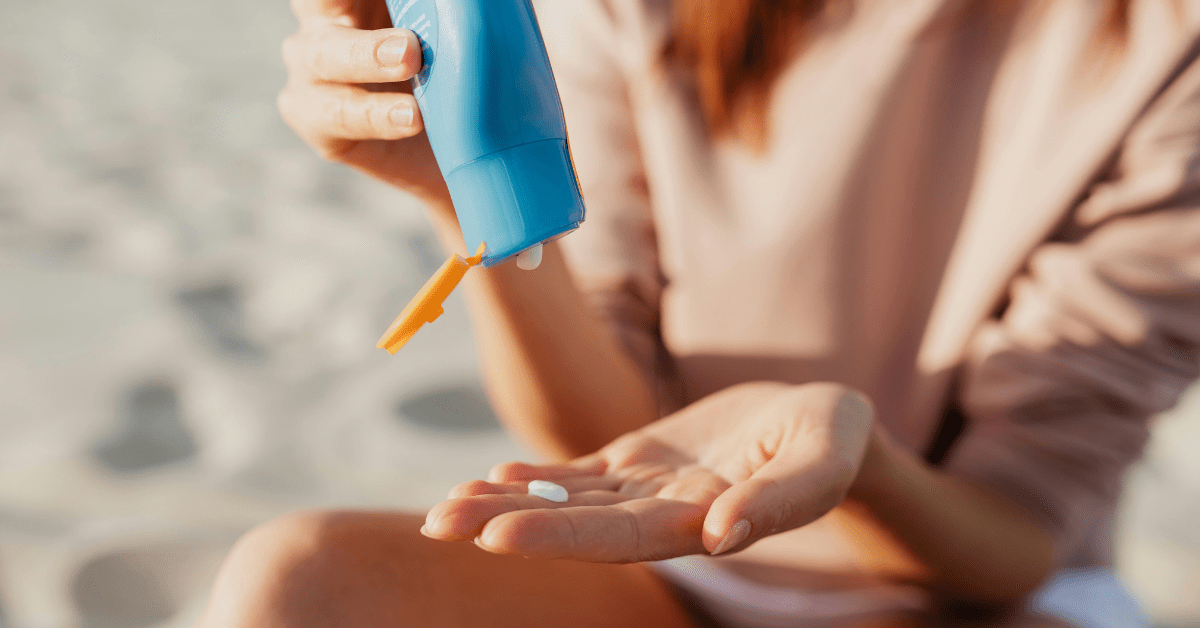
So the amount matters more than the number. A teaspoon for the face, an ounce for the body, fifteen minutes before you go out, every two hours after.
Our standard is zinc oxide and titanium dioxide only, non-nano, fragrance-free, and check the inactive ingredients, because a product can say mineral on the front and still carry chemical filters further down the panel.
Sunscreen is the only step in a skincare routine that is regulated as a drug, tested in a laboratory at a set thickness, and then used by people at about a third of it.
That gap is the whole story. It is why arguing about SPF 30 versus SPF 50 is mostly a waste of a conversation, and why the single highest-value change most people could make to their sun protection is to use more of what they already own.
Here is the mechanism first, because the amounts only make sense once you know what is being measured.
Two kinds of ultraviolet, doing two different jobs
DermNet's ranges: UVB is 280 to 315 nanometers, UVA is 315 to 400. Shorter waves carry more energy, longer waves go deeper, and the consequences split along those lines.
UVB is the burn. DermNet describes it as "the main cause of sunburn and some forms of skin cancer," and it damages the DNA in skin cells directly.
UVA is the aging. It penetrates further, it "contributes to aging skin," and it does its damage largely through oxidative injury rather than by hitting DNA directly. It does not make you red, which is exactly why it gets ignored.
The detail worth carrying around: the Skin Cancer Foundation notes that UVB rays "can be filtered and do not penetrate glass," while UVA "can penetrate windows and cloud cover." A car window on a long drive, a desk by a window, an overcast afternoon. None of those feel like sun exposure and all of them are.
What SPF actually measures, and where it stops meaning anything
SPF is a burn number, and burning is UVB. The FDA defines it as "a measure of how much solar energy (UV radiation) is required to produce sunburn on protected skin ... relative to ... unprotected skin." It is a ratio, not a percentage and not a duration.
The percentages are where the diminishing returns show up. The AAD gives two: "SPF 15 filters out 93% of the sun's UVB rays. SPF 30 filters out 97% of the sun's UVB rays."
Doubling 15 to 30 buys four percentage points. Everything above that buys less, and the FDA agrees: the current rule caps labeling at SPF 50+, and the agency's stated reason is that it does not have adequate data showing products above SPF 50 provide additional protection. There is a proposed order that would raise the cap to 60+, and it is still proposed rather than final.
So SPF 30 to 50 is the sensible range and the argument inside it is not worth having. The number that is worth having an argument about is how much of it you put on.
Broad spectrum is a test, not an adjective
This one surprises people. "Broad spectrum" on a US label is not marketing language, it is a claim a product has to earn by passing a specific FDA test.
Under 21 CFR 201.327, the sunscreen is applied to plates, irradiated, and its absorbance measured across 290 to 400 nanometers. The critical wavelength is the point where cumulative absorbance reaches 90 percent of the total. The rule's language: "A mean critical wavelength of 370 nm or greater is classified as broad spectrum protection."
In plain terms, it has to keep absorbing well into the UVA range rather than dropping off after it has handled the burn. A high SPF with no broad spectrum claim protects you from looking sunburned while doing very little about the part that ages skin. Never buy the first without the second.
Mineral and chemical, with the regulatory status stated accurately
The list of UV filters allowed as active ingredients in US sunscreen is short, it has not been reopened in decades, and exactly two entries on it are minerals.
The FDA's 2019 proposed rule sorted them into three groups, and the detail most articles get wrong is that almost none of it is final:
- Zinc oxide and titanium dioxide were proposed as generally recognized as safe and effective at concentrations up to 25 percent. Proposed. Not finalized.
- PABA and trolamine salicylate were determined not to be, and that part has been finalized. They are out of the monograph.
- Twelve others, including oxybenzone, avobenzone, octocrylene, homosalate and octinoxate, were listed as needing more data before the FDA can decide.
Read that third group carefully, because it is where clean beauty most often overstates its case. Needing more data is not the same as being found unsafe. The FDA asked for absorption and safety studies that were never done back when these ingredients were grandfathered in. That is a gap in the record rather than a finding against them.
Our line is mineral only anyway, and I would rather give you the real reason than a scary one. Zinc and titanium are the only two the FDA has proposed as GRASE, they work by sitting on the surface, and they are the two where the evidence base is settled enough that I am comfortable putting them on a fourteen-year-old every single day for years. That is a decision about a very long exposure, not a verdict on anyone else's chemistry.
Non-nano, and the thing nobody tells you about the word
We specify non-nano, meaning particles large enough to sit on skin rather than be absorbed, and it is most of the reason to choose mineral at all.
Here is what you should know: the FDA has no regulatory definition of the term. Its own 2019 proposed rule says the agency has not established a definition of "nanotechnology," "nanomaterial," "nanoscale" or "non-nano," and that it was not proposing to distinguish nanomaterial zinc oxide or titanium dioxide from other particle sizes.
So non-nano on a label is a claim the brand is making, not a regulated term it had to earn. Ours means what we say it means and we will tell you the particle size if you ask. But a publication that tells you to read labels should also tell you which words on a label have a government standard behind them and which ones do not. This one does not.
The move almost nobody makes: read the inactive list
US sunscreen is an over-the-counter drug, which means it carries a Drug Facts panel, and 21 CFR 201.66 requires that panel to split ingredients into active and inactive.
Only UV filters can appear as actives. Everything else in the bottle is inactive, and the inactive list is not on the front of the package and not in the ad.
Which is how you get a product that says mineral on the front, lists zinc oxide as its active, and still carries a chemical filter or a penetration enhancer among the inactives. The active panel tells you what is blocking UV. The inactive list tells you what else came along. Turn the bottle over and read both, every time, and if you want the ninety-second version of that skill it is in the label Foundation.
How much, which is the part that actually decides your protection
SPF is determined at a laboratory application density of 2 milligrams per square centimeter. Almost nobody applies that much.
The published field work is consistent about it. A review of sunscreen application in Photodermatology, Photoimmunology and Photomedicine puts real-world application in the range of 0.39 to 1.0 mg per square centimeter, a fifth to a half of the tested amount. A field study on a sun holiday, published in Photochemical and Photobiological Sciences, measured 0.79 mg per square centimeter and calculated that for a labeled SPF 15 product this corresponded to an effective SPF of approximately 3.
Read that last number again. Not SPF 7, which is what you would expect if protection scaled with thickness. About SPF 3. The relationship is not linear, and under-application costs you far more than the shortfall suggests.
The amounts, from the AAD
| What | How much |
|---|---|
| Face | "At least 1 teaspoon (about the amount needed to cover the length of your index and middle fingers)" |
| Body | "About 1 ounce of sunscreen, roughly the amount to fill a shot glass" |
| Before | Fifteen minutes, because that is how long absorption takes |
| After | Every two hours, and after toweling off, sweating or swimming |
| Water resistant | Forty minutes in water. "Very water resistant" is eighty. Then reapply. |
The two-finger method you have seen online comes straight from that AAD line about the index and middle fingers. It is a way of visualizing a teaspoon rather than a separate rule with its own research, and it works. Squeeze a stripe down both fingers, put all of it on your face and neck, and do it once properly before you trust your eye. It will feel like far too much. It is the amount the number on the bottle was measured with.
Why this is the step to protect
The 2025 AAP study in Pediatrics that served skincare videos to simulated thirteen-year-old accounts found those routines averaged eleven potentially irritating active ingredients and ran about $168 a month. Only 26 percent of the daytime routines included sunscreen.
Eleven actives, and three out of four routines skipping the only step with a decades-long payoff. That is the entire teen skincare market in one statistic.
Which brings me to the reframe I would put on a poster if I could: the thing that actually prevents visible aging is SPF at fourteen, not retinol at fourteen. Retinoids have real uses and a real age at which they start making sense. Sunscreen has a payoff that starts accruing the day you begin and cannot be recovered later. If a teenager is going to do exactly one thing for their future skin, this is it, and it is the cheapest thing in the routine.
What we actually sell, and what we do not
Sunscreen is the strongly recommended fourth step, and it comes from the Free Living Co. marketplace rather than the Live Free line. Everything in the Sun & SPF collection has to clear the same standard: zinc oxide and titanium dioxide only, non-nano, fragrance-free, with the inactive ingredients read as carefully as the actives.
The first three steps are ours. smooth sali helps skin look clearer and feel smoother, pore magic is a hydrating niacinamide toner, moisturose is the fragrance-free moisturizer. Sunscreen goes on last, over all of it, which is covered in the order Foundation, and it is the step to keep on the mornings you are running late.
One last thing worth knowing if you follow this category: the filter landscape is not frozen. Bemotrizinol is the first new sunscreen filter to move through the US process in twenty-five years, and what happens to it matters more than any single product on a shelf right now.
Until then: a teaspoon, fifteen minutes early, every two hours. The rest of the routine is here.
Dana