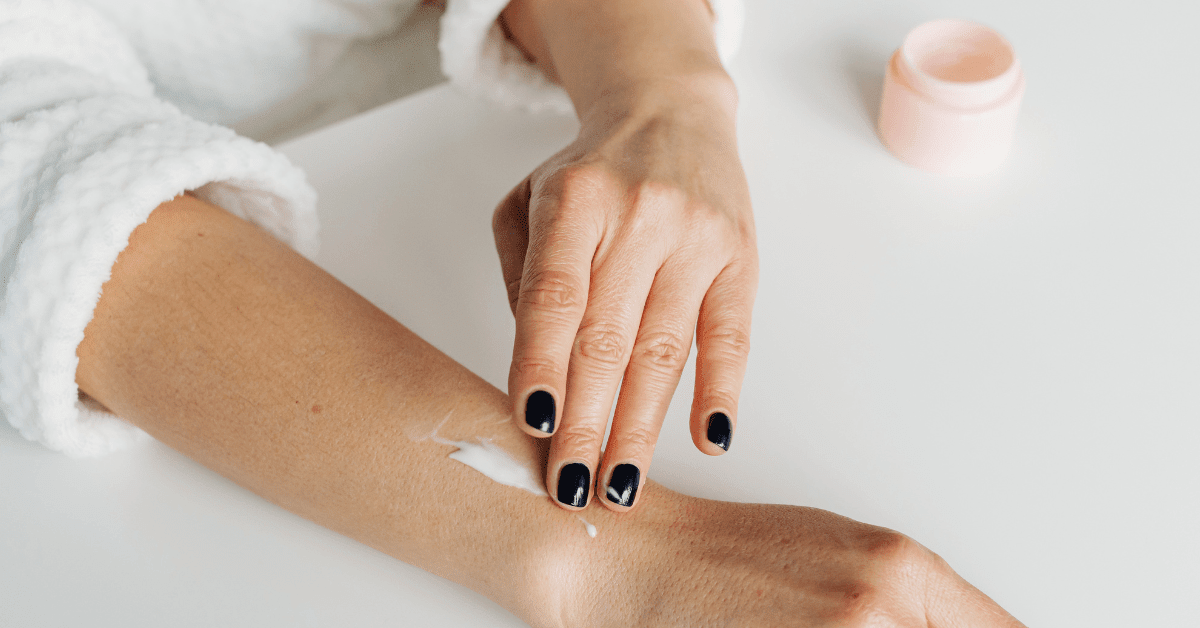
How to Patch Test
Ten days, twice a day, on the inside of your arm. The American Academy of Dermatology's protocol is a quarter-sized spot, "the normal amount and thickness you would use," applied "twice daily for seven to 10 days."
The reason it takes that long is that allergy is slow. An allergic reaction to a product typically shows up 24 to 72 hours after contact, and sometimes only after repeated exposure. One dab and a ten-minute wait proves nothing.
And the honest limit: this catches allergy and irritation. It does not tell you whether something will clog your pores three weeks from now.
The AAD's instruction for testing a new skincare product runs to seven to ten days of twice-daily use. Most people give it about thirty seconds.
That gap is where "this broke me out" comes from. Not all of it, but a real share, and it is the cheapest problem in skincare to avoid. Ten days of using something on your arm costs nothing and it is the difference between finding out on your forearm and finding out on your face the week before something you care about.
Why it takes ten days
Because the reaction you are testing for is delayed by design.
Allergic contact dermatitis is an immune response, and DermNet puts the timing plainly: it "usually appears 24-72 hours after contact with the allergen." Your immune system has to recognize the substance, which takes time, and with some ingredients it takes more than one exposure before it does.
That is the whole argument for the ten days. A single application tests for nothing except an immediate irritant reaction, and immediate irritation is the kind you were going to notice anyway.
Irritant contact dermatitis is the other thing you might see, and it works differently. DermNet describes it as something that "can occur immediately after a single injury or develop slowly after repeated exposure to an irritant." It is not immune-mediated. It is the skin being chemically bothered, which is why an irritant reaction usually stays inside the patch and an allergic one often spreads past its edges.
The protocol
- Pick the spot. The AAD says to "choose a quarter-sized spot on your skin where the product won't be rubbed or washed away, such as the underside of your arm or the bend of your elbow." Inner forearm is the practical answer. Not the back of the hand, which gets washed twenty times a day.
- Use a real amount. "Use the normal amount and thickness you would use as if you were applying the product regularly." A smear thin enough to disappear is not a test of the product, it is a test of a smaller product.
- Twice a day, for ten days. The AAD's window is seven to ten. Take ten. Same spot each time, and do not switch arms halfway through.
- Rinse-off products get a timer. For a cleanser, "keep it on your skin for five minutes or as long as the instructions say." Five minutes is far longer than you would leave a cleanser on your face, which is the point: it is a stress test.
- Read the result. If after ten days you have no reaction, the AAD's verdict is to go ahead and use it. If you do, they are specific about what to do next: "gently wash the product off as soon as possible, and don't use it again." A cool compress or petroleum jelly if it is uncomfortable, and a dermatologist if it is severe and not settling.
The dermatology version, if you want to be thorough
There is a formal version of this called the Repeat Open Application Test. DermNet's protocol is to "apply the product to an area approximately 5 cm by 5 cm" of hairless skin with no dermatitis and no recent sun exposure, then "reapply the product to the same patch of skin twice a day for a week." Forearm, inner elbow, behind the ear or the side of the neck. For a cleanser or shampoo, "wash it off a minute or so later."
It is the same test with a bigger area and a specific site, which is worth doing for anything expensive, anything you have reacted to before, or anything with an ingredient you already suspect. One caveat from DermNet: it is not for known irritants like household detergents.
Reaction, or just adjusting
These get confused constantly, and the difference decides whether you keep going or stop.
A reaction is redness, itching or swelling, which is the AAD's own list. Add blistering, weeping, a rash with a defined edge, or skin that is hot rather than just pink. Anything that is spreading beyond where you applied it is a reaction and it is the one that deserves the most attention.
Adjustment is narrower than people think, and it really only applies to a handful of actives. A mild tingle in the first minute after a retinoid or an acid, some dryness or light flaking in the first couple of weeks, is expected and usually settles. Even then, the standard advice is to go slower rather than push through, and that timeline lives in the piece on how long things take.
The rule I would give a teenager: tingling that fades in a minute is adjusting, anything still happening an hour later is not. And itching is never in the adjusting column.
What this does not catch
I want to be clear about this, because most articles on patch testing quietly imply it covers everything.
A patch test is a test for contact allergy and irritation. Those are the reactions that happen on the surface, on a scale of hours to days. What it does not do is tell you whether a product will clog your pores, because that is a different mechanism on a different clock. A plug forms over weeks, and it forms in follicles on your face rather than on your forearm, which does not have the same follicles or the same oil production.
So a product can pass a perfect ten-day patch test and still, six weeks later, be the reason you have a crop of closed comedones on your chin. That is not a failure of the test. It is a question the test was never asking.
I should say plainly that this limitation is my reasoning rather than something I found stated by the AAD or DermNet. It follows from what the test measures and what a comedo is, and I could not find an authority spelling it out. The practical version of it does have a source, though, and it is the AAD's one-new-thing-at-a-time rule: "it is always best to introduce one new product at a time." That is what catches the slow problems. The patch test catches the fast ones. You want both.
When it is worth doing, and when it is not
Ten days is not free in attention, so spend it where it counts.
- Always, if skin has ever reacted to anything. Sensitivity is a condition rather than a skin type, it comes and goes, and having reacted once makes reacting again more likely. That distinction is in the skin types Foundation.
- Always for anything with fragrance. Fragrance is the single most common trigger in cosmetics, and the word on the label can stand in for a long list you are not shown. How that works is its own piece. It is also why everything we make is fragrance-free.
- Always before a retinoid or a strong acid, and before anything going near eyes or lips.
- Honestly, not for a gentle fragrance-free moisturizer if you have never reacted to anything in your life. Nobody is going to do this for every product forever, and pretending otherwise gets the advice ignored entirely.
One more thing worth doing while you wait: read the label. A patch test tells you how your skin responded. The ingredient list tells you what it responded to, and the two together are how you learn what to avoid next time rather than just learning to avoid one bottle.
For the record, ours go through third-party review rather than asking you to take our word for it. smooth sali, pore magic and moisturose are fragrance-free, MADE SAFE and Leaping Bunny certified. Patch test them anyway. Skin is individual, and certification is about what is in a formula rather than about how yours will answer.
Dana