The Types of Acne, Explained
The Types of Acne, Explained
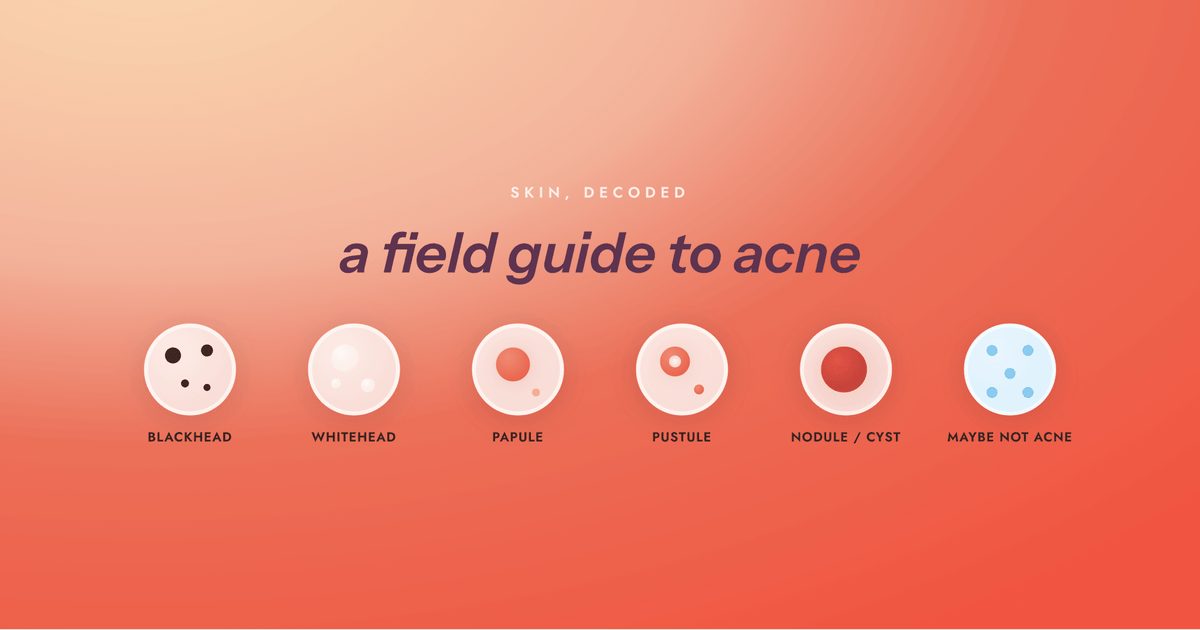
There are two families and one escalation. Comedonal acne is plugs without much redness: blackheads and whiteheads. Inflammatory acne is plugs the immune system has found: papules and pustules. Nodules and cysts are the deep, painful version, and they are a dermatologist's job rather than a shopping problem.
The type matters because it decides what works. A retinoid is aimed at plugs. Benzoyl peroxide is aimed at bacteria. If you buy the wrong one for what you actually have, you will conclude that nothing works, when what happened is that you treated a different problem.
And three common things that look like acne are not acne at all, which is why they never respond to acne products.
About 85% of people between 12 and 24 get at least some acne, according to the American Academy of Dermatology. That is nearly everybody, and almost none of them have the same thing.
Skincare marketing flattens all of it into one word, which is how a person ends up with a cabinet of products that each work brilliantly on someone else. So here is the actual taxonomy, and what each kind responds to. If you want the machinery underneath it, that is its own Foundation: oil, a plug, bacteria, inflammation, in that order.
Family one: comedonal acne
A comedo is a plugged follicle. That is the whole definition. Skin cells that should have shed stick together, mix with sebum, and fill the pore. No bacteria have taken over yet, and the immune system has not arrived, so there is not much redness.
Blackheads (open comedones)
The pore is open at the surface and the plug darkens on top. The color is oxidized pigment, not dirt. DermNet puts it exactly: open comedones are "black because of surface pigment (melanin), rather than dirt." The AAD's advice follows directly from that: "The black dots aren't dirt, so resist scrubbing. It will only worsen your acne."
Blackheads get a Foundation of their own, partly because the advice around them is so bad and partly because most people pointing at their nose are looking at something else entirely.
Whiteheads (closed comedones)
Same plug, sealed over. Small, skin-colored or white, usually not sore. On the forehead and chin they often come in clusters and give skin a bumpy texture in raking light rather than an obvious spot.
Closed comedones are the ones people most often attack with the strongest thing they own, because they are stubborn and they are not going to pop. The AAD's recommendation for both kinds of comedo is a retinoid such as adapalene, which is available without a prescription in the US since 2016, often alongside a benzoyl peroxide wash. Salicylic acid also works on this family, because it is oil-soluble and gets into the pore.
Family two: inflammatory acne
Same plug, but now the follicle wall has given way and the immune system has arrived. This is the red, sore, visible category.
Papules
Small, red, raised, solid. No head. They feel hard, and the AAD notes that if you have a lot of them "the area may feel like sandpaper." They are also the ones most likely to be picked at, because they look like they are about to become something, and they are not.
Pustules
A papule with a visible yellow or white center. The AAD's line is short and worth taking literally: "Resist the temptation to pop these. It can worsen acne." Squeezing pushes contents deeper rather than out, and the dark mark left behind lasts much longer than the spot did.
Nodules and cysts
Deep, firm, often painful, sometimes with no surface opening at all. Cysts are softer and fluid-filled; nodules are hard. Both sit well below what any topical product can reach.
This is the one category where I would rather you stopped reading skincare content and made an appointment. The AAD's framing is not subtle: nodules and cysts "often cause permanent acne scars when they heal," and "the sooner you start treatment, the fewer permanent scars you'll have." There are genuinely effective prescription answers here, and every month spent trying cleansers instead is a month of scarring that did not have to happen.
A field guide, in one table
| What you see | What it is | What it responds to |
|---|---|---|
| Dark dot, flat or barely raised | Blackhead | Retinoid, salicylic acid. Time, not tools. |
| Small pale bump, no head, won't pop | Whitehead | Retinoid first. Patience. |
| Red bump, hard, no head | Papule | Benzoyl peroxide, salicylic acid, retinoid |
| Red bump, yellow or white center | Pustule | Same. Do not squeeze. |
| Deep, painful, larger than a pea | Nodule or cyst | A dermatologist |
| Itchy, uniform, all the same size | Possibly not acne | See below |
Most people have more than one of these at once, which is normal and is why dermatologists usually combine ingredients rather than picking one. The practical version for a teenager is not to run two new actives at the same time on the same night, because irritation reads as more acne and you lose the ability to tell what is working.
Three things that are not acne
These matter more than they sound, because each one gets treated as acne for months, fails to improve, and convinces someone that their skin is hopeless.
Fungal acne (Malassezia folliculitis)
Not acne and not bacterial. It is an overgrowth of a yeast that lives in follicles. The giveaway is uniformity: DermNet describes it as "a monomorphic eruption" in which comedones are not seen, meaning every bump is about the same size and there are no blackheads mixed in. It is often itchy, which real acne usually is not, and it turns up on the chest, back, shoulders and hairline.
It gets worse with heat, humidity, heavy sweating and occlusive products, and it can flare after a course of antibiotics. Standard acne treatments do not work on it, because it is a fungus. Antifungal treatment does. If a teenager's "back acne" is itchy, identical bump to bump and getting worse on antibiotics, that is a conversation with a clinician, not a stronger body wash.
Keratosis pilaris
The rough, goosebump-like texture on the backs of upper arms and the fronts of thighs, and on the cheeks in younger children. The AAD describes the bumps as plugs of dead skin cells, and says many people find they clear in summer and return in winter.
It is extremely common, it is harmless, and it is not a hygiene issue or a sign of anything. The AAD's guidance is that treating dry skin often helps, because dryness makes the bumps more noticeable. What does not help is scrubbing it, which is the first thing most people try. There is more on this in the body acne Foundation, because the two get confused constantly.
Perioral dermatitis
Clusters of small red bumps around the mouth, nose or eyes, often with dry flaky skin and a burning rather than itchy feeling. The tell is that the strip of skin immediately bordering the lips is usually spared.
The most common trigger, per DermNet, is topical steroid use, including a hydrocortisone cream applied to the face for something else. Heavy occlusive creams and some dental products are also implicated. The first step is usually stopping everything on the face rather than adding to it, which is the opposite of the acne instinct, and it needs a clinician to diagnose.
What the type tells you about what to buy
Work backward from the lesion rather than forward from the marketing.
- Mostly comedones. A retinoid is the highest-value thing you can add, and salicylic acid earns its place. Benzoyl peroxide is aimed at a step you do not have much of.
- Mostly red and inflamed. Benzoyl peroxide is genuinely useful here, with the caveat that it bleaches fabric and is drying, and that it has had quality problems worth knowing about.
- Deep and painful. A dermatologist. Not a serum.
- Itchy, uniform, on the body. Stop assuming it is acne.
Underneath whichever of those applies, the baseline does not change, and the AAD's version of it is three things: a gentle cleanser, a fragrance-free moisturizer, and broad-spectrum SPF 30 or higher. That is what our own line is built to cover. smooth sali is a gentle salicylic acid cleanser that helps skin look clearer and feel smoother, pore magic is a hydrating niacinamide toner rather than an astringent, and moisturose is the fragrance-free moisturizer. Sunscreen is the strongly recommended fourth step, and it comes from the Free Living Co. marketplace rather than the Live Free line: every formula in the Sun & SPF collection is zinc oxide and titanium dioxide only, non-nano, fragrance-free, with the inactive ingredients read as carefully as the actives. The full routine is here.
When to stop self-diagnosing
Go to a dermatologist if any of this is true: the spots are deep or painful, they are leaving marks or scars, three months of consistent over-the-counter use has changed nothing, the rash itches, or it is affecting whether someone wants to go to school. None of those are failures of effort. They are just information that the next step is a prescription, and prescriptions for acne are good.
Knowing which kind you have is most of the work. After that, the aisle gets a lot smaller, and the advice you can safely ignore gets a lot larger.
Dana