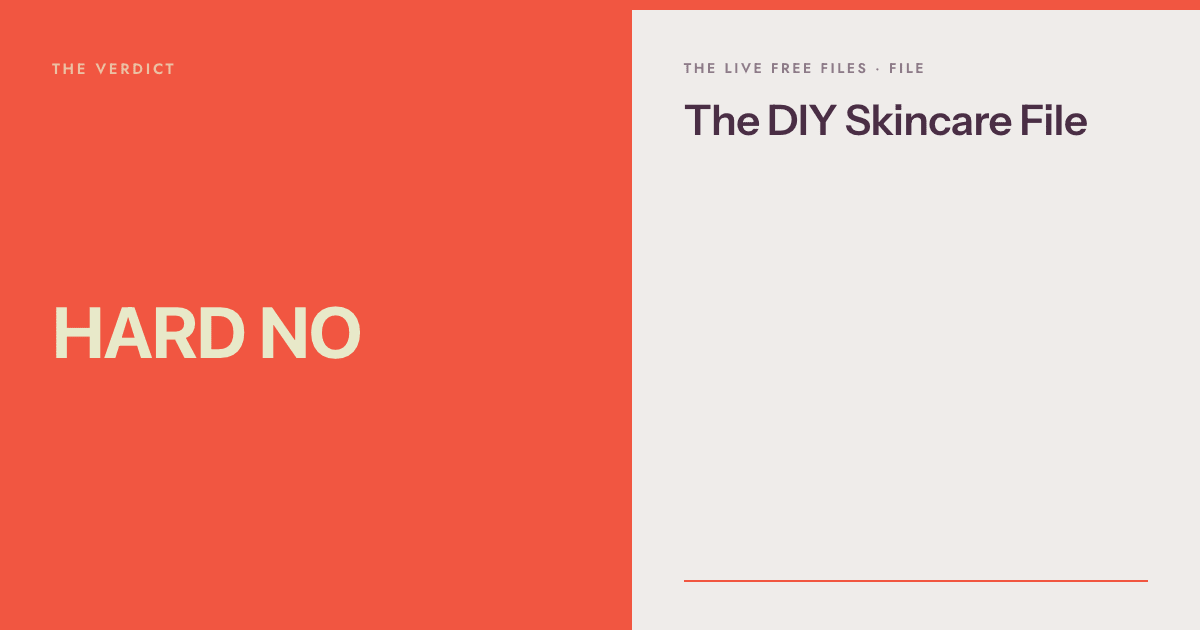
The DIY Skincare File
Five. That's how many kitchen-cabinet skincare "hacks" show up often enough, across enough videos, to need a verdict of their own: lemon juice, baking soda, toothpaste, crushed aspirin and sugar or salt scrubs. This is the first Hard No in this library, and that tier means something specific: not "we'd rather you didn't," but a named mechanism of physical harm. All five clear that bar, individually, for different chemical reasons, and it's worth naming each one rather than lumping them into a single vague warning, because the specifics are what make the case rather than the tone.
Lemon juice: a chemical burn triggered by sunlight
Lemon juice, along with lime and other citrus, contains compounds called furocoumarins. Applied to skin and then exposed to sunlight, furocoumarins trigger a reaction called phytophotodermatitis, which is not sensitivity or irritation in the ordinary sense. It's a chemical burn, activated by UV light, that can cause blistering and dark, sometimes long-lasting discoloration in the exact shape of wherever the juice touched skin. It's common enough after outdoor citrus contact, a squeezed lime at a cookout, that emergency rooms see a seasonal pattern of it. Deliberately applying lemon juice to the face as a "brightening" treatment and then going outside is applying the exact trigger for a burn, on purpose, to the most visible part of the body.
Baking soda: the wrong pH by a wide margin
Healthy skin sits at a naturally acidic pH, generally in the range of about 4.7 to 5.7, a layer dermatologists call the acid mantle, which helps hold the barrier together and keep out bacteria that prefer a more neutral environment. Baking soda has a pH of roughly 9, sharply alkaline. Washing with it doesn't gently cleanse skin, it strips the acid mantle and pushes skin pH toward a range where the barrier stops functioning the way it's built to, leaving skin more prone to irritation, dryness and breakouts, the opposite of what it's being used to fix.
Toothpaste: formulated for teeth, not for skin
Toothpaste is engineered to clean enamel, and the ingredients that do that job, abrasive particles, foaming agents like sodium lauryl sulfate, whitening compounds, and often menthol or peppermint oil for a "clean" sensation, are not formulated with skin's tolerance in mind at all. Dabbed on a blemish overnight, the traditional use case for this one, it commonly causes redness, peeling, and in some cases a genuine chemical burn from the concentrated menthol or abrasive contact against skin that has none of the built-in resistance tooth enamel has.
Crushed aspirin: uncontrolled acid at an unknown strength
Aspirin is acetylsalicylic acid, which is chemically related to the salicylic acid used in real acne treatments, including smooth sali. The similarity ends at the name. A formulated salicylic acid product is manufactured at a specific, tested concentration, buffered to a pH that skin can tolerate, and tested for how it behaves once it's actually on skin. A crushed pill mixed with water is none of those things. The concentration depends on how many pills, how much water, and how thoroughly it's crushed, which means every application is a different, untested strength applied directly to skin with no buffering at all. Uncontrolled concentration is the actual mechanism of harm here, not the ingredient itself.
Sugar and salt scrubs: physical damage with a texture
Sugar and salt granules are sharp-edged and irregular at the microscopic level, nothing like the smooth, uniform spheres or gentle chemical exfoliants formulated products actually use. Scrubbed against skin, especially skin that's already inflamed from a breakout, they create micro-tears, tiny breaks in the skin's surface too small to see individually but real enough in aggregate to worsen inflammation, spread acne-causing bacteria across the face instead of removing it, and slow healing rather than speeding it.
"Natural" is not the same claim as "safe"
Part of what makes this list persuasive is that every ingredient on it is something you'd eat or already use elsewhere in the house, which makes it feel inherently gentler than a product with an ingredient list you don't recognize. Worth saying plainly: natural is not a safety category. Lemon juice is natural and it's the single most burn-prone item on this list. Poison ivy is natural too. Whether something belongs on skin depends on its actual chemistry and concentration, not on whether it came from a plant, a kitchen shelf, or a lab. A formulated product with an ingredient list you don't immediately recognize has, in most cases, been tested for exactly the things a kitchen substitute never has: pH, concentration, and how it behaves once it's actually sitting on skin for a while.
Why this keeps circulating anyway
Part of the appeal is real and worth taking seriously rather than dismissing: skincare marketed to teenagers is expensive, and a video promising a free fix using things already in the kitchen is responding to a genuine problem, cost, with an answer that feels empowering rather than extractive. That instinct isn't the issue. The specific five methods above are. A cheap, safe routine is entirely achievable, which is the whole point of the next section, and doesn't require touching any of the five ingredients above.
The instead, because free is the actual appeal
Part of why these five keep circulating is that the honest alternative, real products, feels like it costs more than a squeeze of lemon or a spoonful of baking soda already in the kitchen. It doesn't have to. A basic fragrance-free cleanser runs about $10 to $15. A properly formulated toner does the "toning" job these hacks are usually chasing without the pH damage. If breakouts are the actual problem the lemon juice or the toothpaste dab was aimed at, an actual salicylic acid cleanser like smooth sali targets the same concern at a controlled, tested concentration, for the price of maybe two months of the ingredients these five hacks require buying anyway.
The free version isn't actually free. It's a cost deferred to later, paid in a burn, a scar, or a barrier that takes weeks to recover, instead of paid up front for something built to do the job safely.
Put together, a genuinely complete routine, cleanser, a real toner if one is wanted, moisturizer and sunscreen, runs somewhere around $60 to $80 total to start, and most of that is a one-time cost since a bottle lasts months. That's not nothing, but it's also not the barrier it's sometimes framed as next to a free kitchen substitute, especially measured against what an urgent care visit for a chemical burn costs, or what a scar takes to fade, which for some skin tones can be months to years rather than days.
Why this rules on the practice, not on a person
Plenty of these ideas circulate because someone genuinely believed they were sharing something helpful, often because it worked for them once without a visible reaction, or because it's framed as an alternative to an industry that has, in fairness, oversold plenty of things itself. That context matters, and it's exactly why this verdict names the five practices and the chemistry behind each one rather than any specific person or account. The mechanism of harm is the same regardless of who demonstrated it or how well-intentioned the post was.
What to tell your kid
"Lemon juice can literally burn your skin if you go outside after using it, that's an actual chemical reaction, not an old wives' tale. Baking soda's pH is way too high for skin and it wrecks your barrier. Toothpaste is made for teeth, not faces, and it can burn too. Crushed aspirin has no controlled strength, so you have no idea how strong what you're putting on your face actually is. And sugar or salt scrubs tear your skin at a level you can't even see. None of these are cheap hacks. They're all real ways to actually hurt your skin, and there are real, affordable products that do the same jobs safely."
What to tell your parents
"I've seen the lemon juice and baking soda stuff online and I want you to know I'm not doing any of it. Lemon juice can actually cause a chemical burn if you're in the sun afterward, and baking soda's pH is way too high for skin. I'd rather spend a little on an actual cleanser that's formulated to be safe than save a few dollars and risk a burn or a scar."
Go deeper
Read what actually causes acne before reaching for any home remedy aimed at it, and what actually removes blackheads, which covers several more of these DIY methods specifically.
Claims about furocoumarins and phytophotodermatitis, skin's acid mantle pH range, and the chemistry of acetylsalicylic acid reflect standard dermatological and chemical references. Pricing reflects typical retail cost of basic fragrance-free cleansers and formulated salicylic acid products.
Dana